The Rifugio System in the Central Apennines
Italy's mountain refuge system has two distinct tracks: refuges directly managed or co-managed by CAI sections, and privately operated structures that hold CAI affiliation. Both types appear in the national refuge directory at rifugi.it and on CAI topographic maps. The practical difference for walkers is in reservation culture and overnight pricing. CAI-managed huts typically require reservation in advance only during July and August; private-affiliated huts vary considerably.
In the central Apennines, the refuge network is less dense than in the Dolomites or the western Alps. This is a structural feature of the range: the Apennines lack the concentrated circuit-hiking infrastructure that the Italian alpine north built over the twentieth century. Most central Apennine refuges serve as endpoints or midpoints on single multi-day routes rather than nodes in a dense network. Understanding which refuges are positioned where — and when they are actually staffed — is essential for planning any route longer than a day walk.
Gran Sasso Refuges: Elevation and Access
Rifugio Franchetti (2,433 m)
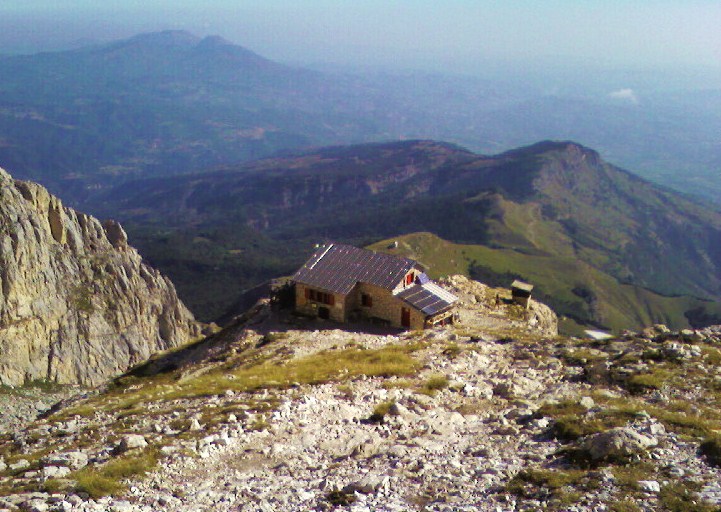
The highest staffed refuge in the central Apennines, positioned on the north face of the Gran Sasso massif above Isola del Gran Sasso d'Italia. Run by the CAI Teramo section. Capacity approximately 70 beds. The approach from the valley takes 2.5–3.5 hours depending on starting point. Typically open from mid-June to late September; winter access is possible but the hut operates in an unmanned bivouac configuration outside the staffed season. Reservation is strongly advised for July and August weekends.
Rifugio Duca degli Abruzzi (2,388 m)
Positioned below the main summit block on the southern side, approached from the Campo Imperatore plateau. Managed by the CAI L'Aquila section. This is the starting point for the most commonly used route to Corno Grande (2,912 m), a 1–1.5 hour scramble from the refuge. Capacity around 60 beds. Open late June to late September. The approach from Campo Imperatore station (reachable by cable car from Assergi) takes 1.5–2 hours and is graded E.
Rifugio Campo Imperatore (2,130 m)
A larger hotel-refuge complex on the plateau, part of the Gran Sasso ski infrastructure. Open year-round with variable services. Not primarily a walking refuge but useful as a base for plateau day routes and as a weather refuge. Reservation required; accessible by road as well as cable car.
Monti Sibillini Refuges
The Sibillini refuge network is sparser than the Gran Sasso system and reflects the less-visited character of the range. Several Sibillini huts experienced damage or operational interruption following the 2016 earthquake sequence. As of 2026, most have either reopened or been replaced with temporary structures.
Rifugio Città di Ascoli (1,998 m)
Located on the eastern flank of Monte Vettore, the highest Sibillini peak. Managed by the Ascoli Piceno CAI section. Capacity approximately 50 beds. Typically open late June through September. The 2016 earthquake affected nearby paths; the southern approach via the Lago di Pilato basin has been rerouted.
Rifugio del Fargno (1,819 m)
In the northern Sibillini, near the Forca di Presta pass. Privately operated with CAI affiliation. Open from late May in good years, extending into October. Useful staging point for the northern Sibillini ridge traverse. Capacity around 30 beds in dormitory and small rooms.
The Northern Apennines: A Different Model
The Ligurian and Emilian Apennines operate a partially different refuge model. Several huts here are managed by regional Alpine clubs (CAI Liguria, CAI Emilia-Romagna) and are positioned lower — typically between 900 and 1,500 metres — reflecting the lower maximum elevations of the northern range.
These lower-elevation refuges often function more like mountain trattorie, offering full meals rather than the standard dormitory board of high-alpine huts. The season can extend into November on the lower Ligurian routes, and weekend reservations should be made well in advance during the September–October autumn window when the northern trails see their highest use.
Reservation and Pricing Conventions
Reservation practices vary. Most central Apennine refuges can be booked by phone or email, and an increasing number have online booking via rifugi.it or their own sites. The standard overnight rate (pernottamento con cena e colazione — dinner, dormitory bed, breakfast) in CAI-managed central Apennine huts ranges from €45 to €65 per person as of 2025–2026, with slight variation by section and distance from a road-accessible resupply. CAI members receive a discount, typically €5–8 per night.
Bivouac fee for the unmanned winter configuration (where a hut leaves sleeping space and basic shelter available outside the staffed season) is generally expected but not always enforced — the CAI section's website for the specific hut clarifies the arrangement.
Planning a Multi-Day Route around the Refuges
The most practical multi-day traverse using central Apennine refuges is the Gran Sasso Circuit, a 4–6 day route that circumnavigates the main massif using Rifugio Franchetti, Rifugio Duca degli Abruzzi, and intermediate bivouac shelters. No single published guidebook covers the full circuit without gaps; the CAI L'Aquila and CAI Teramo sections produce separate route sheets that together document the route.
For the Sibillini, the most commonly completed multi-day route links the Piano Grande di Castelluccio with Rifugio Città di Ascoli and continues north along the ridge, returning via the western face. This is a 3–4 day route at grade E/EE, with one section near Monte Vettore's summit block that requires careful route-finding after the earthquake-related path changes.